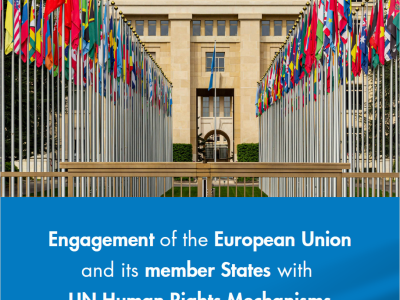
Human Rights Mechanisms
The OHCHR Representation Office to the EU (ROEU) promotes the UN human rights mechanism and processes like the Treaty Bodies, the Human Rights Council, the Universal Periodic Review, and the Special Procedures, by giving visibility to their work at the regional and national levels.
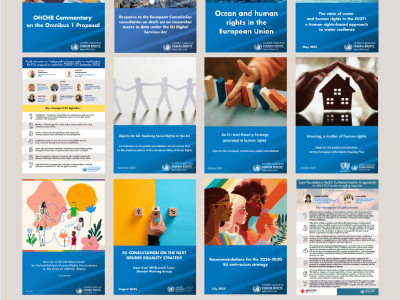
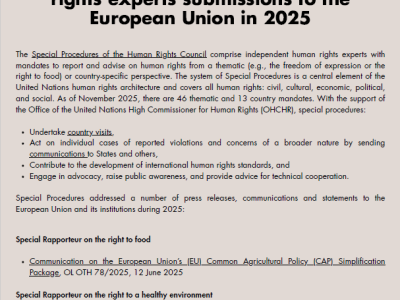
UN Special Procedure mandate holders regularly submit analysis to the EU (e.g. in human rights areas like migration, civic space, business and human rights, the environment).
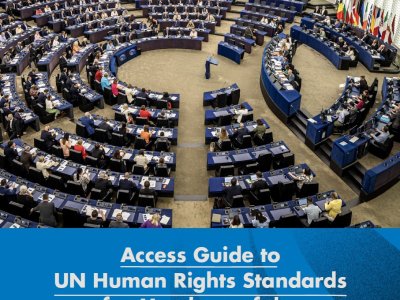
ROEU facilitates the engagement of Special Procedure mandate holders and Treaty Body experts with the European Parliament, and in events organized by EU institutions, regional organizations, academic institutions or civil society or the United Nations including our own Office.
The human rights recommendations of the United Nations human rights mechanism or bodies provide a strong basis and compass for the work of the ROEU. They feed into our analysis and contributions to EU legislative and policy initiatives or assessments, like the annual European Commission’s Rule of Law Report (see here).
The Office also facilitates the interaction of the European Union, States, national human rights institutions, civil society organizations and human rights defenders with the UN human rights mechanisms. This publication outlines current EU and EU Member State engagement with the UN Human Rights Mechanisms to facilitate this engagement.
There are different human rights monitoring mechanisms in the UN system:
UN Charter-based bodies and bodies created under the international human rights treaties and made up of independent experts mandated to monitor State parties' compliance with their treaty obligations.
Universal Human Rights Index (UHRI)
If you wish to explore observations and recommendations made by the international human rights protection system (Treaty Bodies, Universal Periodic Review, Special Procedures) for a specific country or per theme, you can use the Universal Human Rights Index (UHRI).
Charter-Based and Treaty-Based Bodies
CHARTER-BASED BODIES
The 1945 United Nations Charter proclaims that one of the purposes of the United Nations is to promote and encourage respect for human rights and fundamental freedoms for all.
In this context, the Universal Declaration of Human Rights, adopted by the United Nations General Assembly in 1948, spells out, for the first time in history, the fundamental rights and freedoms that all human beings should enjoy. Its provisions have been developed in international human rights treaties, including the International Covenant on Civil and Political Rights and the International Covenant on Economic, Social and Cultural Rights.
The Declaration also laid the groundwork for the human rights architecture that is nowadays composed of the main human rights mechanisms:
The Human Rights Council is an intergovernmental body, which meets in Geneva, and is composed of 47 elected UN Member States. It is a forum empowered to promote and protect all human rights around the globe. Among others, it addresses situations of urgency and has established a number of inquiry, investigative, and fact-finding bodies.
Under the auspices of the Human Rights Council, two human rights mechanisms assess the state of play of human rights at national level and/or thematically:
- The Universal Periodic Review (UPR), a peer review by States which involves a review of the human rights records of all UN Member States. The UPR is a State-driven process, under the auspices of the United Nations Human Rights Council, which provides the opportunity for each State to declare what actions it has taken to improve the human rights situations in their countries and to fulfil their human rights obligations. As one of the main features of the Council, the UPR is designed to ensure equal treatment for every country when their human rights situations are assessed.
- The Special Procedures of the Human Rights Council, comprising independent human rights experts with mandates to report and advise on human rights from a thematic (e.g., the freedom of expression or the right to food) or country-specific perspective. The system of Special Procedures is a central element of the United Nations human rights machinery and covers all human rights: civil, cultural, economic, political, and social. As of April 2026, there are 46 thematic mandates and 13 country mandates.
TREATY BODIES
The human rights Treaty Bodies are committees of independent experts, whose mandates emanate from the nine core human rights treaties and one optional protocol. Each State party to a treaty has an obligation to take steps to ensure that everyone in the State can enjoy the rights set out in the treaty.
The ten human rights treaty bodies are composed of independent experts of recognized competence in human rights, who are nominated and elected for fixed renewable terms of four years by State parties.
MANDATES & FUNCTIONS
These human rights mechanisms have different mandates, procedures and activities, which in turn shape the ways in which (i) States in their capacity as duty-bearers, (ii) individuals as the rightsholders, (iii) other national or international stakeholders (NHRIs, CSOs etc.), and (iv) the United Nations Country Teams (UNCT), engage with them.
Some conduct country visits or inquiries to monitor specific human rights issues; others consider complaints by individuals who allege that their rights have been violated by a State; and almost all of them have an established reporting procedure for assessing the progress of States in meeting their human rights obligations.
Independently of their functions, all three mechanisms generate recommendations to the States with the aim of contributing to short-term and long-term changes in legal and policy frameworks to improve human rights protection. These can be consulted at the Universal Human Rights Index.
See Also
- Committee on the Elimination of Racial Discrimination (CERD - 1969)
- Committee on Economic, Social and Cultural Rights (CESCR - 1976)
- Human Rights Committee (CCPR - 1976)
- Committee on the Elimination of Discrimination against Women (CEDAW - 1979)
- Committee against Torture (CAT - 1987)
- Committee on the Rights of the Child (CRC - 1990)
- Committee on Migrant Workers (CMW - 2003)
- Subcommittee on Prevention of Torture (SPT - 2006)
- Committee on the Rights of Persons with Disabilities (CRPD - 2008)
- Committee on Enforced Disappearances (CED - 2010)