

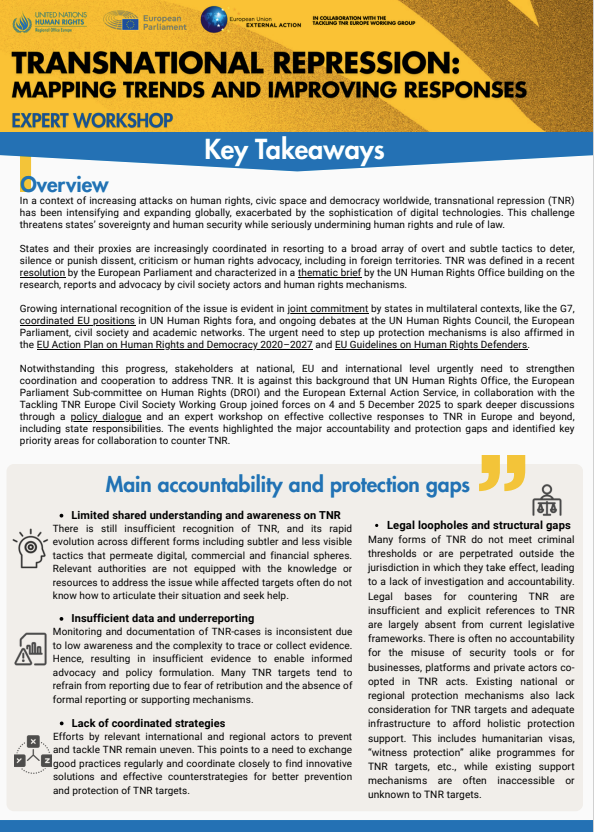
Transnational Repression Expert Workshop’s Key Takeaways
On 4-5 December 2025, OHCHR Europe, the European Parliament Sub-committee on Human Rights (DROI) and the European External Action Service, in collaboration with the Tackling TNR Europe Civil Society Working Group organized a policy dialogue and expert workshop to map trends and improve responses on Transnational Repression (TNR).
Based on discussions during the expert workshop, the organizers published Key Takeaways to encourage and inform future reflections and collaborative efforts to address the issue.
In a context of increasing attacks on human rights, civic space and democratic institutions worldwide, transnational repression (TNR) is intensifying globally, including through the use of digital technologies, with serious implications for human rights, the rule of law and States’ sovereignty. While international recognition of TNR is growing, significant accountability and protection gaps remain.
Here are the main gaps and challenges experts and stakeholders identified:
- Legal and structural gaps: TNR is often not explicitly addressed in legislation, falls below criminal thresholds or occurs across jurisdictions, limiting investigation, accountability and protection.
- Insufficient data and underreporting: Low awareness, fear of reprisals and the lack of safe reporting mechanisms contribute to limited documentation of TNR cases.
- Limited awareness and understanding: Relevant actors often lack the knowledge and tools to identify and respond to TNR, including in its evolving and less visible forms.
- Lack of coordinated strategies: Efforts to prevent and address TNR remain fragmented between national, regional and international levels.
Participants also elaborated a number of recommendations to improve responses through collaborative efforts:
- Joint strategies and political will: Strengthening a coordinated approach between the UN, EU and national levels, in partnership with civil society.
- Holistic protection: Ensuring accessible reporting, tailored protection mechanisms as well as adequate resources for TNR targets.
- Data collection: Improving monitoring and analysis through shared methodologies and cooperation among stakeholders.
- Awareness and capacity building: Expanding training, guidance and outreach for authorities and communities.
- Accountability: Enhancing cooperation, legislative review and accountability mechanisms to address TNR effectively.
Learn more about TNR in the OHCHR thematic brief released in June 2025.